Care Guide
Make Your Plushie Washing-Machine Safe
Most soft toys die in the washer. Here's how to make yours survive.
The Three Enemies
Tugging (loosens seams)
Soaking (weakens thread)
Centrifugal force (throws toy against drum)
Before sewing — Design stage
Use short stitches (1.8mm – 2.0mm length)
Why: Standard stitches (2.5mm) are too long. Tugging pulls thread between stitches. Short stitches lock thread in place.
Double stitch all stress points (arms, legs, neck)
Sew forward, then backward over the same line.
Why: Appendages get yanked hardest. Double stitching creates a backup line of defense.
Use interfacing on thin fabrics
Why: Thin cotton tears easily when wet. Interfacing (stiff backing ironed onto fabric) strengthens weak spots.
The “Washing Machine Test” construction
No poly pellets inside the body
Why: Pellets break from repeated spinning. Broken pieces escape through seams and become choking hazards.
Close the seam completely
Do NOT leave a small gap. Leave a 4-inch gap for turning, but close it with a ladder stitch that is double-threaded.
Why: Small gaps (1 inch) are impossible to close tightly enough for machine washing. Larger gaps give you room to sew properly.
Reinforce the closing
After finishing your ladder stitch, tie a triple knot. Apply a tiny dab of fabric glue directly onto the knot only (not the thread tails).
Why: Thread absorbs water and weakens. The knot is the weakest point. Sealing just the knot with fabric glue keeps it locked without exposing the toy to excess chemicals. Never use Fray Check or nail polish on baby toys — these contain solvents that aren't safe for mouthing.
How to wash — Step-by-step
01
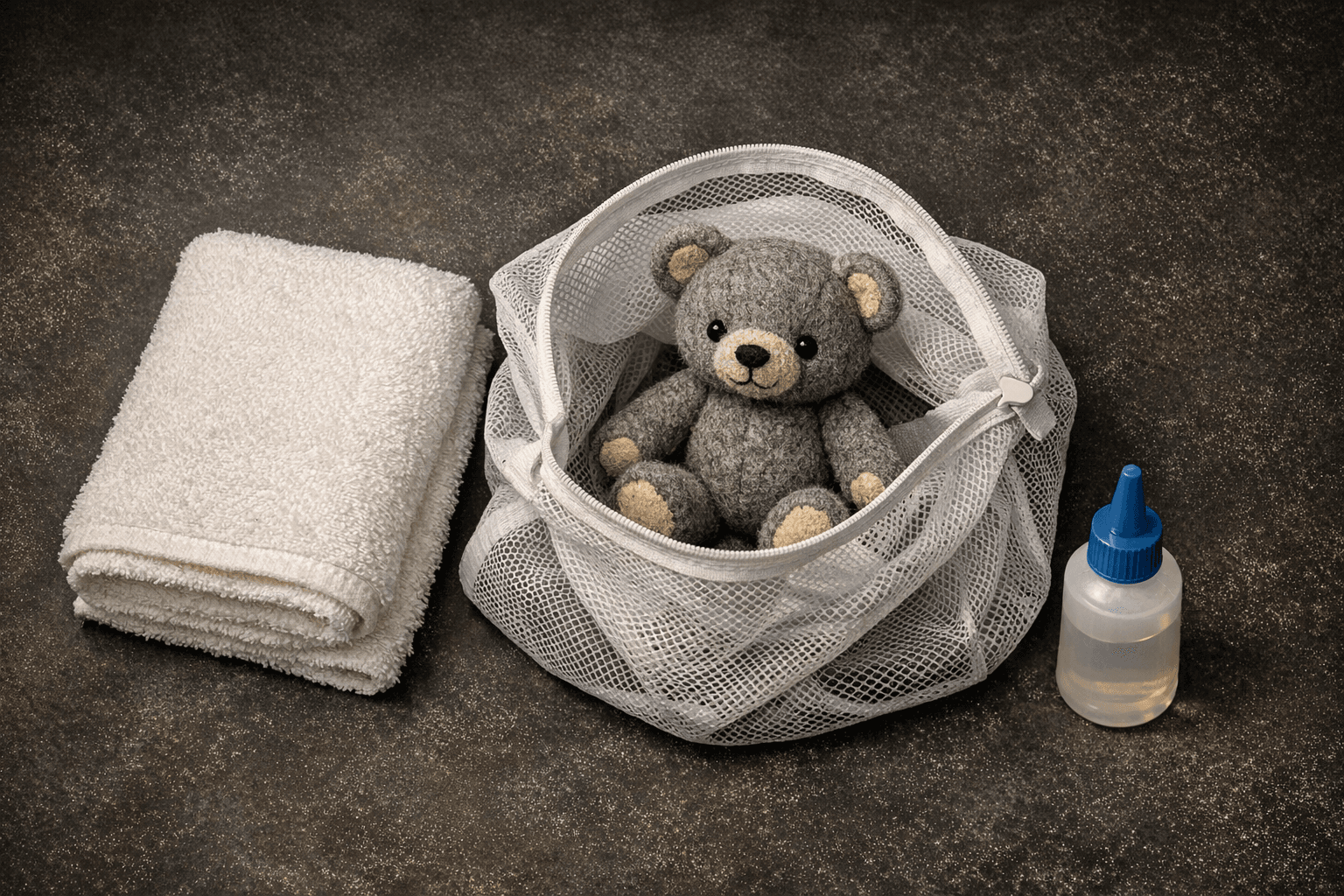
Use a laundry bag or pillowcase
Put plushie in a zippered laundry bag or tied pillowcase.
Why: The bag contains the toy during spin cycle so it doesn't smash against the drum repeatedly.
02
Add towels to the machine
Why: Towels act as cushions and shock absorbers. They fill empty space so the toy doesn't bounce violently.
03
Use cold water, delicate cycle
Why: Hot water melts the glue that holds safety eyes together. Heat also shrinks some fabrics unevenly.
04
NO spin cycle — or lowest possible spin
Why: High-speed spinning is what breaks seams. The water is gone; you don't need spin.
05
Air dry only
Why: Dryer heat melts polyester fabric fibers and rusts any internal wire armatures.